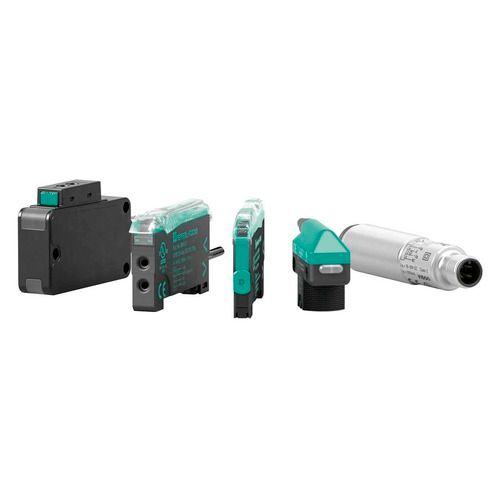
Pepperl Fuchs Fiber Optic Sensors Price & Specifications
Wireless No
Weight Approx. 70 g
Voltage 10-30 V DC
Usage Industrial automation, process control, assembly lines
Signal Type Digital/Discrete
Sensor Type Photoelectric (Fiber Optic)
Sensitivity Adjustable via potentiometer or push button
Response Time <1 ms
Resolution <1 mm (depending on fiber and amplifier design)
Product Type Fiber Optic Sensor
Power Consumption <800 mW
Output Transistor (PNP/NPN, NO/NC selectable)
Operating Temperature -25A C to +55A C
Mounting Type DIN rail or panel mount
Measurement Range Up to 2000 mm (depending on fiber type)
Material ABS Plastic, Polycarbonate (housing and transparent covers)
Interface Wire connection (M8 or M12 connector optional)
Input Light signal via fiber optic cable
IP Rating IP65 (amplifier housing)
Function Detection of objects, positioning, and presence monitoring
Features Compact design, fast response, simple configuration, LED status indicator
Cable Length 2 m standard
Application Detecting small objects or from tight installation locations
Accuracy High precision (application-dependent)
About Pepperl Fuchs Fiber Optic Sensors Detail
We are dealer and supplier of Pepperl Fuchs Fiber Optic Sensors in India.
Models:
- SU19/110/115/123
- SU18/16/35/40a/110/115/126a
- SU19.1/110/115
- OJ500-M1K-E23
- SU18-40a/110/115/126a
- VL18LL-M/40a/118/128
- MLV41-LL-IR-2492
- MLV41-LL-RT-2492
- RL61-LL-IR-Z/92/136
- SU18-16/40a/102/115/126a
- SU18-16/40a/110/115/126a
- SU18-16/40a/110/115a
- SU18-16/40a/110/115a/126a
- SU18-16/40a/115a/120
- SU18-40a/102/115/123
- SU18-40a/102/115/126a
- SU18-40a/110/115/123
- SU18-40a/110/115a/126a
- SU18/35/40a/102/115/123
- SU18/35/40a/110/115/123
- SU18/35/40a/110/115/126a
- SU18/35/40a/110/115a/126a
- SU19/102/115/123
- SU19/102/115/126a
- SU19/103/115/123
- SU19/110/115/126a
- SU19/110/115a/126a
- VL18LL-M/30/40a/118
- VL18LL-M/32/40a/118
- MHP-F33L
- MHP-F33Q
- MLV41-LL-IR-1347
- MLV41-LL-IR-2133
- MLV41-LL-IR-IO/115/136
- MLV41-LL-IR-IO/92/136
- MLV41-LL-IR-IO/95/136
- MLV41-LL-IR/115/136
- MLV41-LL-IR/70/136
- MLV41-LL-IR/92/136
- MLV41-LL-IR/95/136
- MLV41-LL-RT-IO/115/136
- MLV41-LL-RT-IO/92/136
- MLV41-LL-RT-IO/95/136
- MLV41-LL-RT/115/136
- MLV41-LL-RT/92/136
- MLV41-LL-RT/95/136
- RL61-LL-IR-Z/115/136
- RLK61-LL-IR-Z/31/115
- RLK61-LL-IR-Z/31/135
- SU18-16/40a/102/115a/126a
- SU18-40a/102/115a/123
- SU18-40a/110/115a
- SU18-40a/110/115a/123
- SU18/16/35/40a/102/115/126a
- SU18/16/35/40a/110/115a
- SU18/16/35/40a/110/115a/126a
- SU18/35/40a/102/115/126a
- SU19.1/102/115
- SU19.1/103/115
- SU19.1/110/115a
- SU19/82a/103/115
- ML17-LL-K/115/136
- ML17-LL-K/115b/136
- MHP-FR33L
- MHP-FR33Q
- ML17-LL-K/136/143
- ML17-LL-K/73/136
- MPG6HD
Versatility Across Industrial ApplicationsThese fiber optic sensors cater to diverse industrial requirements, adapting seamlessly to automation, process control, and assembly line tasks. Their ability to detect small objects in confined spaces, along with compatibility with both plastic and glass fibers, makes them ideal for complex setups and varied environmental conditions.
Reliable Performance in Challenging EnvironmentsEngineered with ABS plastic and polycarbonate materials, the sensors exhibit excellent durability and can withstand ambient light up to 30,000 lux. Reverse polarity and short-circuit protection reinforce safety, while the compact design and IP65-rated housing guarantee longevity and robust operation in demanding industrial locations.
Ease of Configuration and InstallationWith simple teach-in, manual adjustment capabilities, and LED indicators for power/output state, setup is intuitive and monitoring is effortless. Flexible mounting options, including DIN rail and panel installations, facilitate quick deployment while minimizing downtime or complex wiring, streamlining integration into existing automation systems.
FAQs of Pepperl Fuchs Fiber Optic Sensors:
Q: How do I configure the Pepperl+Fuchs Fiber Optic Sensor for different detection applications?
A: The sensor can be configured using either a Teach-in procedure or manual adjustment via potentiometer or push button. This flexibility allows you to set sensitivity levels precisely for detecting various object sizes or materials, ensuring optimal performance for your specific application.
Q: What materials are compatible with the fiber optic cables used in these sensors?
A: These sensors work efficiently with both plastic (PMMA) and glass fiber optic cables, offering versatility for different environmental and detection requirements. Choose the cable material that best matches your applications durability, flexibility, and mounting constraints.
Q: When is the ambient light immunity especially beneficial in these sensors?
A: Ambient light immunity up to 30,000 lux is critical in brightly lit environments, such as manufacturing floors with intense overhead lighting or near open windows. It ensures reliable object detection and reduces the likelihood of false triggering caused by external light sources.
Q: Where can I install the Pepperl+Fuchs Fiber Optic Sensors?
A: These sensors are designed for easy installation in tight or otherwise inaccessible locations. Their compact size suits DIN rail or panel mounting, and the IP65-rated amplifier housing makes them suitable for use in harsh industrial environments, including assembly lines and automated machinery.
Q: What is the typical process for integrating these sensors into an automation system?
A: Integration involves mounting the sensor (DIN rail or panel), connecting the fiber optic cable, wiring the output (PNP/NPN, NO/NC selectable), and configuring sensitivity. LED status indicators assist in verifying successful setup and operation, simplifying the installation and commissioning stages.
Q: How does using these sensors benefit my industrial automation process?
A: These sensors enhance process reliability by providing fast response times (<1 ms), high resolution (<1 mm), and robust object detection even in challenging conditions. Their adaptability, protection features, and simple configuration lead to reduced downtime and improved operational efficiency.
Q: What usage scenarios are best suited for these photoelectric fiber optic sensors?
A: They excel in detecting small or fast-moving objects, positioning tasks, and presence monitoring where space is limited. Their flexible fiber compatibility and high precision are advantageous in assembly lines, packaging, and process control applications within industrial automation.

 GST No.27ACRPG0717F1ZQ


 Our Products